
Oct. 12-13, 2026 @ The Syracuse University Washington, DC Center (SUDC)
Sponsored by the Army Research Office
This workshop is by invitation-only. Please email Prof. Paulo Shakarian to be added to the interest list.
Location: The Syracuse University Washington, DC Center, 1333 New Hampshire Ave NW 9th floor, Washington, DC 20036
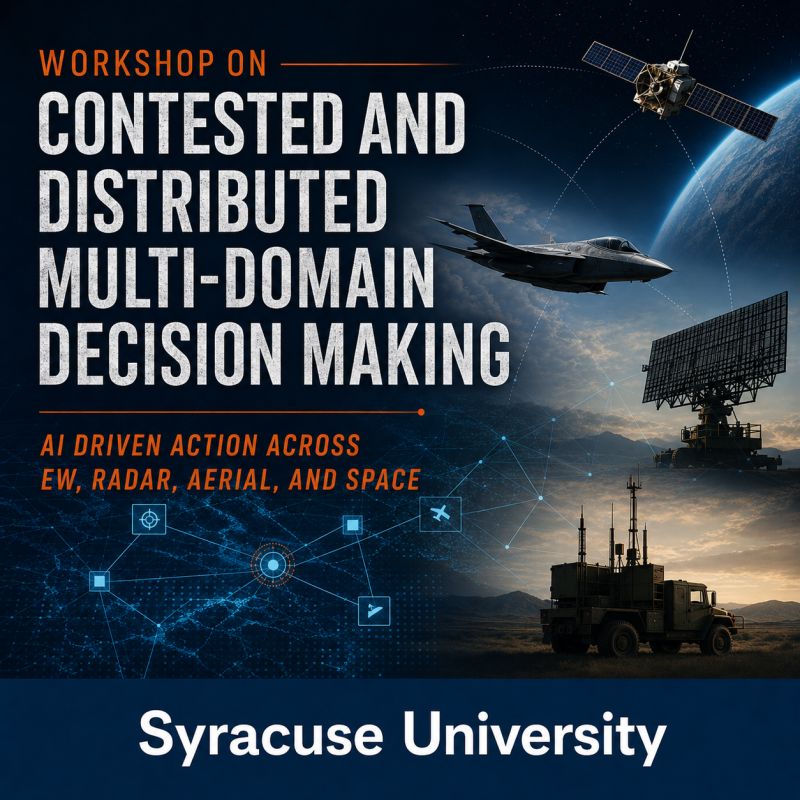
Modern multi-domain operations increasingly depend on artificial intelligence for decision making across the electronic warfare (EW), radar, aerial, and space domains. As adversaries develop sophisticated capabilities to contest the electromagnetic spectrum and disrupt communications, there is a critical need to understand how AI-driven systems can both exploit and defend against such threats. This workshop will bring together researchers from academia, government, and industry to address the intersection of AI and contested multi-domain environments, with a focus on shared world models, collaborative human-agent teaming, and resilient autonomous decision making under adversarial conditions.
Effective collaboration across mixed teams of humans and autonomous agents requires mechanisms for propagating relevant information in a coherent shared world model, even in uncertain, adversarial environments with limited or degraded communications. Electronic attack (EA) capabilities such as jamming can degrade sensor information and reduce the navigation and decision-making capability of mobile platforms [2]. Understanding these dynamics—and developing AI-based countermeasures—is essential for maintaining operational advantage in contested environments.
The objectives of the workshop are as follows:
- Explore AI techniques for positioning EW assets to disrupt adversary AI-driven decision making (e.g., communication disruption in distributed/federated learning, sensor deception and perception manipulation)
- Investigate AI-based approaches for defending against EW threats (e.g., ensuring robust autonomous behavior under jamming and interference) [1], [2], [3], [4]
- Advance AI-based decision making for spectrum management under adversarial conditions [1], [3]
- Address the challenge of tracking maritime vessels that disable automatic identification system (AIS) tracking [5]
- Develop methods for coping with distribution shift caused by interference patterns in contested electromagnetic environments
- Understand how EW actions fit into larger multi-domain courses of action spanning aerial, space, and ground operations
- Identify requirements for simulation environments that support multi-domain battlefield planning with EW as a key domain
Specific topics to be covered include, but are not limited to:
- AI-driven electronic attack and electronic support planning
- Shared world model development and dissemination under contested communications
- Robustness of federated and distributed learning under adversarial EW conditions [1]
- AI for radar and spectrum sensing in adversarial environments [4], [7]
- Maritime domain awareness and tracking under denial conditions [5]
- Space-based sensing and communication resilience
- Multi-agent systems and computational game theory for EW scenarios
- Managing bandwidth limitations and resolving model inconsistencies in shared world models
- Recognizing and combating deception in multi-domain operations [6]
- Human-agent teaming and collaboration in contested environments
Biography of Workshop PI, Paulo Shakarian. Paulo Shakarian, Ph.D. is the K.G. Tan Endowed Professor of Artificial Intelligence at Syracuse University. He specializes in artificial intelligence and machine learning, publishing numerous scientific books and papers. Shakarian was named a “KDD Rising Star,” received the Air Force Young Investigator award, received multiple “best paper” awards and has been featured in major news media outlets such as CNN and The Economist. Paulo has been funded by various organizations including IARPA (HAYSTAC, CAUSE, ICARUS), ARO (3x), ONR (5x), and AF/AFOSR (2x). Paulo also co-founded a startup company that used machine learning to predict future exploits; the company was acquired after raising $8 million in venture capital and having obtained over 80 customers. Earlier in his career, Paulo was an officer in the U.S. Army where he served two combat tours in Iraq, earning a Bronze Star and the Army Commendation Medal for Valor. During his military career, Paulo also served as a DARPA Fellow and as an advisor to IARPA. He holds a Ph.D. and M.S. in computer science from the University of Maryland, College Park, and a B.S. in computer science from West Point.
Biography of Workshop Co-PI, M. Cenk Gursoy. M. Cenk Gursoy, Ph.D. is a Professor in the Department of Electrical Engineering and Computer Science at Syracuse University. His research interests include wireless communications, signal processing, information theory, and machine learning, with a focus on communications and sensing in contested electromagnetic environments. He has published extensively in leading IEEE journals and conferences and has been funded by agencies including NSF and Air Force STTR program. He is currently an Associate Editor-in-Chief of IEEE Transactions on Vehicular Technology and an Area Editor of IEEE Transactions on Wireless Communications. He received the NSF CAREER Award, His expertise in electronic warfare, radar systems, spectrum management, and reinforcement learning is directly relevant to the objectives of this workshop.
References.
[1] F. Wang, M. C. Gursoy, and S. Velipasalar, “Robust Network Slicing: Multi-Agent Policies, Adversarial Attacks, and Defensive Strategies,” IEEE Transactions on Machine Learning in Communications and Networking, vol. 2, pp. 49-63, 2024.
[2] X. Wang and M. C. Gursoy, “Resilient Path Planning for UAVs in Data Collection under Adversarial Attacks,” IEEE Transactions on Information Forensics & Security, vol. 18, pp. 2766-2779, 2023.
[3] Y. Shi, Y. E. Sagduyu, T. Erpek and M. C. Gursoy, “How to Attack and Defend NextG Radio Access Network Slicing With Reinforcement Learning,” IEEE Open Journal of Vehicular Technology, vol. 4, pp. 181-192, 2023.
[4] F. Wang, C. Zhong, M. C. Gursoy, and S. Velipasalar, “Resilient Dynamic Channel Access via Robust Deep Reinforcement Learning,” IEEE Access, vol. 9, pp. 163188-163203, 2021.
[5] D. Bavikadi, N. Lee, P. Shakarian, C. Parvis, “Sea-cret Agents: Maritime Abduction for Region Generation to Expose Dark Vessel Trajectories,” 24th Intl. Conf. on Autonomous Agents and Multiagent Systems (AAMAS-2025).
[6] M. Albanese, A. De Benedictis, S. Jajodia, P. Shakarian, “A Probabilistic Framework for the Localization of Attackers in MANETs,” 17th European Symposium on Research in Computer Security (ESORICS 2012).
[7] Z. Lu, M. C. Gursoy, C. K. Mohan and P. K. Varshney, “Constrained Deep Reinforcement Learning for Cognitive Radar Resource Management,” IEEE Transactions on Radar Systems, 2026.